Your Art Practice Needs a Different Plan Once the Light Goes Early
Quick Answer: Shorter days break creative routines in two specific ways: the light you worked by disappears and the evening slot you used gets colonized by other things. Fix the light with one good lamp at the right color temperature, and move the practice to a time that still exists. A twenty-minute morning session survives autumn; a two-hour evening session does not.
Something strange happens in September to people who make things. The work gets worse, then it gets less frequent, then it stops.
It’s almost never a loss of ideas. It’s that the conditions the practice depended on quietly disappeared, and nobody redesigned around it.
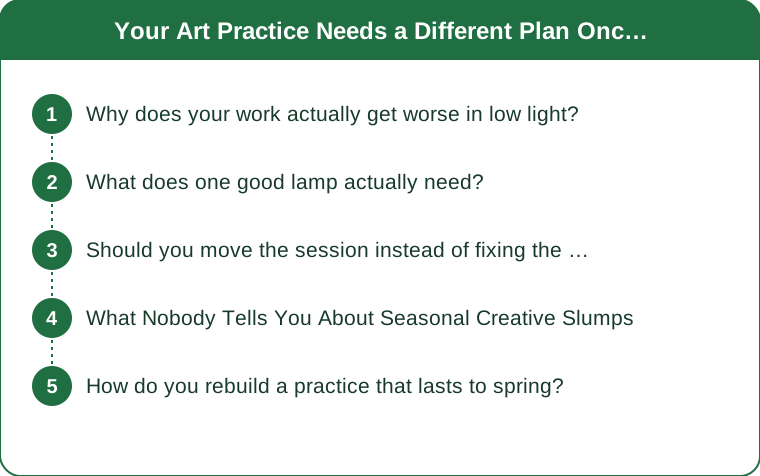
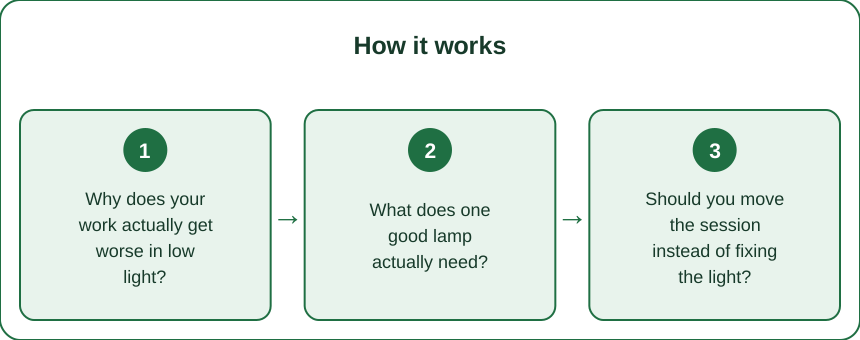
Why does your work actually get worse in low light?
Because your eyes are doing something different than you think they’re doing.
In dim conditions your vision shifts toward rod-dominant seeing — the light-sensitive cells that handle low light but carry almost no color information and much less fine detail. This is why colors flatten and edges soften in a room that still feels perfectly usable to you.
The practical consequence: a painting mixed under warm evening lamplight often looks wrong in daylight, and a drawing that felt well-balanced at 9pm can look muddy the next morning. You weren’t making bad decisions. You were making decisions with less information than you had in July.
There’s a second effect. Working in dim light means your eyes work harder to resolve detail, which produces genuine eye fatigue after 30 to 45 minutes rather than the two hours you managed in summer. The session doesn’t end because you ran out of ideas.
Both problems have the same fix, and it isn’t willpower.
What does one good lamp actually need?
Three numbers, and most people only know one of them.
Brightness. Aim for roughly 1,000 lumens or more directed at your working surface, not at the room. A ceiling fixture lighting a whole room gives you a fraction of that where it matters. An adjustable arm lamp positioned close is worth more than a brighter fixture further away, because light falls off with the square of distance — doubling the distance quarters the light.
Color temperature. For color work, 5000K to 5500K approximates daylight. For drawing and writing, warmer is fine and easier on the eyes. If you only buy one lamp and you work with color, buy the daylight-balanced one.
CRI — Color Rendering Index. This is the number almost nobody checks and it matters most. It measures how accurately a light source shows colors compared to natural light. Cheap LEDs often sit around CRI 80, which renders reds and skin tones poorly. Look for CRI 90 or above. The price difference is small; the difference in mixed color is not.
One good lamp positioned correctly beats three bad ones, and it’s the single purchase most likely to keep an autumn practice alive.
Should you move the session instead of fixing the light?
Often, yes — and this is the change with the higher return.
Audit which slot actually died. For most people it’s the evening, because summer evenings are long, warm, and unclaimed. Autumn evenings are dark, cold, and immediately filled with everything that no longer happens outdoors.
The slots that survive:
- Early morning, before the day makes claims. Shorter, but genuinely protected.
- A fixed lunch break, which is the most underrated creative slot and requires no negotiation with anyone at home.
- A single weekend block, treated as an appointment rather than an intention.
What matters is that the slot still exists in December. A time that works only while the weather is mild isn’t a slot, it’s a coincidence.
And shrink it deliberately. A twenty-minute daily session produces far more finished work over three months than a two-hour session scheduled twice and cancelled once. The frequency is what maintains the thread; the duration only determines how much gets done per sitting.
What Nobody Tells You About Seasonal Creative Slumps
The slump is real, common, and largely predictable — and almost nobody frames it as a scheduling problem, which is what it usually is.
A few things that go unsaid:
Almost everyone’s output drops in autumn. If you compared notes with other people who make things, you’d find the same three-week dip in late September and early October, every year. It reads as a personal failure because it happens in private.
Less light genuinely affects mood and energy for a meaningful fraction of people, and that shows up in creative work before it shows up anywhere else — creative work being the first thing to get cut when energy is scarce. Morning light exposure, ideally outdoors within an hour of waking, is the intervention with the strongest support behind it. If mood changes are significant or persistent, that’s worth raising with a doctor. This is general information, not medical advice.
The work you make in a slump isn’t representative. Judging your ability by what you produce in the worst three weeks of the year is a measurement error, but people quit on exactly that evidence.
Winter is historically productive for a lot of makers, once the transition is over. The dip is the adjustment, not the season.
What helps: keep going at reduced scale rather than stopping, and don’t evaluate anything until November.
How do you rebuild a practice that lasts to spring?
Five things, in order of return:
1. Set the light up once and leave it. A lamp you have to position each time is a lamp you’ll stop using. Clamp it, aim it, done.
2. Leave the work out. The biggest friction in a short session is setup. A sketchbook open on a desk with a pencil on it gets used; a sketchbook in a drawer doesn’t. If your medium doesn’t allow that, at least leave the surface clear.
3. Define the minimum. Ten minutes, one page, one small study. The purpose of a minimum isn’t productivity — it’s that you sit down at all, and sitting down is what preserves the habit.
4. Change the medium to fit the conditions. If your practice was watercolor on a bright balcony, autumn is a good time for graphite, ink, or digital work — all of which tolerate imperfect light far better. This isn’t a compromise; it’s how a lot of people find new directions.
5. Put it on a calendar with a real time. Not a goal. An appointment.
And one seasonal note worth acting on now: the next few weeks are the last stretch of decent natural light in the late afternoon. If there’s a piece you want to make that genuinely needs daylight, make it in the next three weeks. After mid-October, that window closes until February.
TL;DR:
- Low light shifts you toward rod-dominant vision — colors flatten, detail softens, and your decisions get worse without feeling worse.
- One lamp at 1,000+ lumens, 5000K, CRI 90+, positioned close, fixes most of it.
- The bigger fix is usually moving the slot to one that still exists in December — morning, lunch, or a weekend block.
- Almost everyone dips in late September. Reduce scale, don’t stop, and don’t evaluate until November.
- Leave the work out, define a ten-minute minimum, and pick a medium that tolerates imperfect light.
The practice didn’t fail. The hour it lived in got dark.
Keep Reading
This article is for general informational and styling purposes only. Fit, sizing, and product availability may vary.