Why Finishing Matters More Than Starting for a Calming Art Habit
Quick Answer: Unfinished creative work does not sit neutrally. Open tasks tend to occupy attention in a way completed ones do not, so a stack of half-done pieces generates a persistent low-level pull rather than the calm you started the hobby for. Deliberately finishing small pieces - even badly - changes the emotional register of the whole practice, because the closure is where the relief lives. The practical fix is to shrink the scope until finishing is nearly guaranteed: one sitting, one small surface, and a rule that finished beats good.
You started this to feel calmer. Now there is a drawer of abandoned attempts, a folder of 40 percent-done drawings, and a faint guilt every time you open the cupboard - which is precisely the opposite of the point.

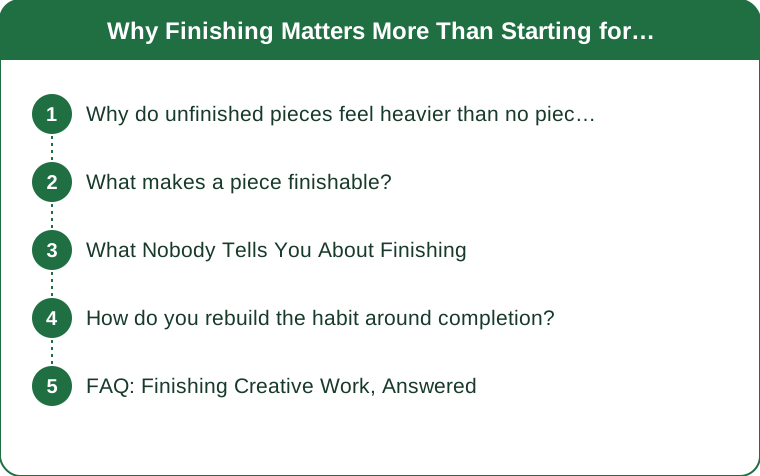
Why do unfinished pieces feel heavier than no pieces at all?
Open loops occupy attention. Psychology has a long-standing observation that interrupted or incomplete tasks tend to stay accessible in memory in a way completed ones do not - the general pattern behind the Zeigarnik effect. Whether or not the effect holds as strongly as originally described, most people recognize the experience: the unfinished thing keeps surfacing.
Each unfinished piece carries an unresolved decision. It is not just an object - it is a pending judgment about whether it is worth continuing, whether it is any good, and what that means about you. Ten of those in a drawer is ten small pending judgments.
And the pile builds a specific narrative. People with a stack of abandoned work almost universally read it as evidence that they do not follow through, which is a heavier interpretation than the facts support and which makes starting the next piece harder rather than easier.
The calm you were seeking lives in the closure. The satisfaction of a creative session comes substantially at the end - the moment of stepping back from something complete. A practice that never reaches that moment delivers the effort without the payoff, which is a strange arrangement to keep repeating.
None of this means unfinished work is shameful. Some pieces genuinely should be abandoned. The problem is not the existence of abandoned work - it is the ratio, and it is the absence of any completed work to balance it.
What makes a piece finishable?
Three constraints, and they all point the same direction: smaller.
One sitting. If the piece cannot be completed in the time you actually have - which for most people is 20 to 40 minutes - it will span multiple sessions, and every gap is an opportunity to abandon it. Scale the ambition to the session, not the other way round.
A small surface. A postcard, an index card, a page in a small sketchbook. Large surfaces demand more decisions and more time, and they are the single most common reason a piece stalls. Working small is not a lesser version of the practice - it is the version that gets finished.
A limited palette or a limited set of tools. Three colors, or one pen. Fewer options means fewer decisions, and decision volume is what drains a session and stalls a piece. This is also why so many people find a restricted palette unexpectedly calming.
Add a defined stopping condition before you start. When the card is covered. When the timer goes. When I have drawn all five objects. Without a stopping rule, a piece has no natural end, and pieces without ends do not get finished - they get abandoned.
And accept a deliberately low bar for done. Signed and dated in the corner is done. Not fixed, not improved, not resolved - done. The finishing habit is what you are training, and it needs repetitions far more than it needs quality.
What Nobody Tells You About Finishing
Nobody tells you that finishing badly is a skill worth practicing. The ability to declare something complete when you can still see everything wrong with it is the specific capacity that separates people with a sustained practice from people with a drawer. It gets easier with repetition, like anything.
Nobody tells you the last 10 percent is where the learning is. The end of a piece - resolving edges, deciding when to stop, handling the part that went wrong - is the part most people never practice, because they abandon before reaching it. Ten finished postcards teach more than three abandoned large pieces.
Nobody tells you that finishing changes what you make next. A completed piece is information: you can see what worked, what did not, and what you would do differently. An abandoned piece teaches almost nothing because you never saw how it resolved.
Nobody tells you the pile is worth clearing deliberately. Going through the unfinished work once and sorting it into finish-this-week, genuinely-abandon, and keep-as-reference removes most of the weight. Throwing things away is allowed. It is often the single most relieving hour in a creative practice.
And nobody tells you that displaying finished work matters more than it sounds. A small stack of completed cards on a shelf, or a few pinned to a wall, changes how you see your own practice - from a series of attempts into a body of work. It is a small ceremony and it does real work.
How do you rebuild the habit around completion?
Run a one-week postcard experiment. One small card per session, finished in one sitting, signed and dated regardless of quality. Seven days. Almost everyone who does this reports the practice feeling different by day four, and the difference is entirely about closure rather than about improvement.
Set the timer for slightly less time than you have. Working against a slightly tight clock forces decisions and prevents the endless refinement that turns a 20-minute piece into an unfinished one.
Keep a separate practice space for experiments. A dedicated scrap sketchbook where nothing needs finishing removes the pressure from exploration, so your finishing habit and your playing habit stop competing.
Deal with the existing pile before adding to it. One sorting session: finish, abandon, or archive. The abandon pile can go in the recycling with no ceremony, and it will feel much better than expected.
Date everything. A dated sequence of small finished pieces is the most motivating record a creative practice can produce, and it takes two seconds per piece.
And keep the ambitious piece - just do it alongside. This is not an argument against large or long work. It is an argument for having a reliable stream of completions running underneath it, so the long piece is not the only thing standing between you and any sense of progress.
FAQ: Finishing Creative Work, Answered
Why do I never finish creative projects?
Most commonly because the scope is larger than the sessions available, so every piece spans multiple sittings and each gap is a chance to abandon it. Shrinking the surface and setting a stopping condition before you start fixes most of it.
Does finishing actually matter if the hobby is just for calm?
The calming payoff of a creative session is concentrated at the end - the moment of stepping back from something complete. A practice that never reaches completion delivers the effort without the relief, and the accumulating unfinished pile adds its own low-grade pressure.
What should I do with my pile of unfinished work?
Sort it once into finish-this-week, abandon, and archive. Recycling the abandoned pile is allowed and usually feels significantly better than expected - it removes a set of pending decisions you have been carrying.
How small should a piece be to be finishable?
Small enough to complete in a single realistic session - for most people a postcard or an index card in 20 to 40 minutes. Working small is not a lesser practice; it is the version that produces finished work and therefore the version that teaches you the most.
TL;DR:
- Unfinished pieces occupy attention and carry pending judgments, so a growing pile works against the calm you started the hobby for.
- The satisfaction of a creative session lives at the end - a practice that never completes delivers effort without payoff.
- Make pieces finishable by design: one sitting, one small surface, a limited palette, and a stopping condition decided before you start.
- Practice finishing badly - declaring something done while you can still see its flaws is the specific skill that sustains a practice.
- Sort the existing pile once into finish, abandon, and archive, and display the finished work where you can see it.
You did not take this up to accumulate evidence of things you did not complete. Shrink the piece until finishing is nearly guaranteed, and the practice starts giving back what you came for.
Keep Reading
This article is for general informational and styling purposes only. Fit, sizing, and product availability may vary.