Why Posting Your Art Online Can Quietly Kill the Calm It Gave You
Quick Answer: A creative hobby delivers calm largely through absorbed, non-evaluative attention - a state that requires no audience. Introducing an audience shifts your attention from the process to the anticipated reception, which replaces the absorbed state with a self-monitoring one. The fix isn’t necessarily to stop posting, but to separate the two clearly: a private practice that stays private, and, if you want it, a separate deliberate sharing practice.
You started drawing to quiet your head. Now you finish a piece and immediately think about whether it’s good enough to post, and somewhere along the way the thing that helped you relax became another thing you might be failing at.

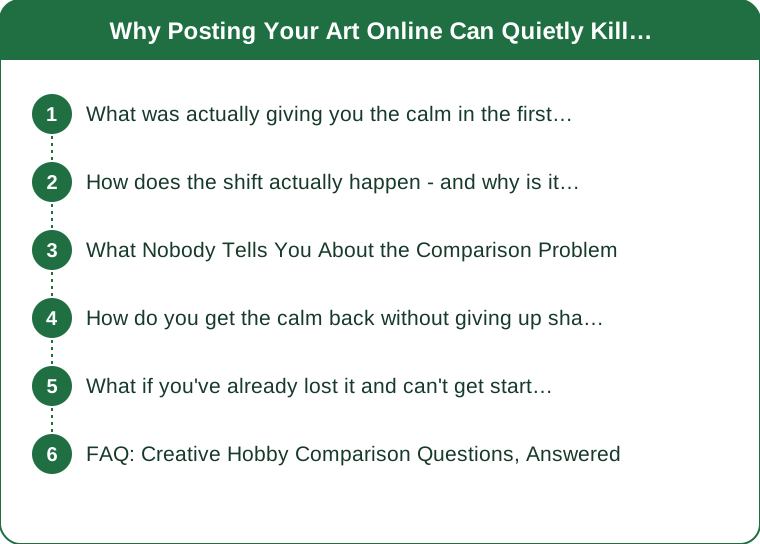
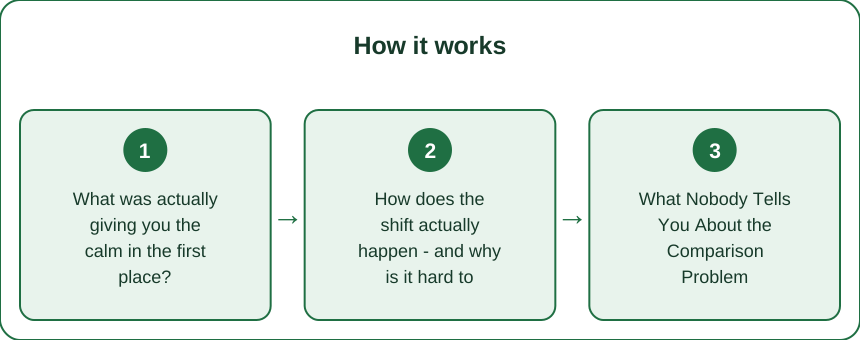
What was actually giving you the calm in the first place?
The calming effect of a creative hobby comes largely from absorbed attention - a state where your attention is fully occupied by the task itself, with no bandwidth left for self-monitoring or rumination.
Two features make it possible:
The task occupies just enough of your capacity. Difficult enough to require attention, not so difficult that it produces anxiety. This is why beginner-friendly practices like colouring, zentangle, and simple watercolour work so well - they hit that band easily.
There is no evaluation happening. Nothing is being judged, including by you. This is the fragile part, and it’s the part an audience breaks.
When you introduce an anticipated audience, part of your attention moves to simulating how it will be received. You’re now running two processes: making the thing, and modelling other people’s reactions to it. The second one consumes exactly the attentional capacity that absorption required.
The result is a practice that looks identical from the outside and functions completely differently. Same materials, same time investment, entirely different psychological effect.
How does the shift actually happen - and why is it hard to notice?
It’s gradual, which is why people rarely catch it in progress.
Stage 1: You share something and it feels good. Genuine positive feedback on something you made is a real pleasure. Nothing has gone wrong yet.
Stage 2: You start finishing pieces with sharing in mind. Subtle at first - choosing a subject that will photograph well, working on the piece that’s furthest along rather than the one you feel like doing.
Stage 3: Unposted work starts to feel like it didn’t count. A sketchbook page you don’t share becomes ‘just practice’ rather than the thing itself.
Stage 4: You avoid starting things you might not finish well. This is the stage where the hobby stops being restorative, because starting badly is a required part of any creative practice and you’ve now made it costly.
Stage 5: You do it less, and feel worse about doing it less.
The reason it’s hard to notice is that each step is reasonable on its own. Nobody decides to turn their hobby into a performance. It happens one small optimisation at a time.
What Nobody Tells You About the Comparison Problem
Your feed is a highlight reel with the timeline removed. The person whose watercolour looks effortless has three hundred failures you’ll never see, and possibly fifteen years of practice. Social platforms strip out duration entirely, which makes everyone’s skill look innate.
Algorithms optimise for impressive, not representative. What surfaces is what performs - which is systematically the top end of what exists. You are comparing your Tuesday evening to a curated global maximum.
Engagement doesn’t track quality. It tracks timing, format, hashtags, and how the platform happened to feel about your account that week. Treating it as feedback on your work means accepting noise as signal.
Getting good at something can reduce your enjoyment of it if the reason you got good was external. Skill acquired in pursuit of approval tends to raise your standards faster than your ability, which produces a permanent gap.
The people whose work you envy often envy someone else’s. There’s no level at which comparison resolves. This isn’t a stage you pass through by improving.
Nobody is looking as closely as you think. The flaw you’re agonising over is invisible to everyone scrolling past at normal speed - which is either liberating or deflating, depending on why you were posting.

How do you get the calm back without giving up sharing entirely?
The instinct is to quit posting. That works, and it’s more drastic than necessary for most people. The more sustainable fix is separation.
Keep a genuinely private practice. One sketchbook, one medium, or one time slot that is structurally not shareable. Some people use a physical sketchbook they never photograph. The rule has to be absolute, because a ‘probably private’ practice still runs the audience simulation.
Batch your sharing. Post once a week or once a month from finished work, rather than considering it as you go. This removes sharing from the making process entirely, which is where the damage happens.
Delete the app from your phone during making time, or simply put the phone in another room. The physical distance does more than intention.
Change what you post. Posting process, mess, and failures rather than finished pieces changes the relationship substantially - partly because it’s honest, and partly because it makes unfinished work postable, which removes the pressure to only start things you’ll complete well.
Set a rule about looking at other people’s work before you start. Fifteen minutes of scrolling immediately before picking up a pen sets a comparison anchor that will follow you through the whole session.
Notice the tell. If you find yourself photographing a piece before it’s finished, that’s the audience simulation running. It’s a useful signal rather than a failure.
What if you’ve already lost it and can’t get started at all?
This is common and it’s more fixable than it feels.
Change the medium. If watercolour has become loaded, pick up something you’re genuinely bad at and have no aspirations for. Being a rank beginner is protective - there’s no audience, no standard, and no history.
Set a deliberately low-stakes constraint. Five minutes. One page. Cheap paper. A pen you don’t like. The point is to make the work unpostable by design, which removes the whole apparatus.
Work on something with a fixed outcome. Colouring books, paint-by-number, and pattern-based work like zentangle all remove the ‘is it good’ question because the outcome is largely determined. For people who’ve lost the calm to comparison, these are genuinely useful re-entry points rather than lesser activities.
Give it a job that isn’t art. Sketching to remember a place, drawing to think through a problem, doodling while on the phone. Work with a non-aesthetic purpose sidesteps evaluation entirely.
Accept a fallow period. Sometimes the answer is a few weeks away from it. A hobby you return to voluntarily is in better shape than one you force.
When it’s more than a hobby problem: if the pattern of self-evaluation and comparison extends well beyond your creative practice - into work, relationships, or how you feel generally - that’s worth talking to someone about. This is general information, not medical advice.
FAQ: Creative Hobby Comparison Questions, Answered
Is it wrong to want people to see what I make?
No. Wanting to share is normal and social. The problem is specifically when anticipated reception enters the making process itself.
How long does it take to get the calm back?
Many people notice a difference within two or three sessions of a genuinely private practice, though rebuilding the habit takes longer.
Does this apply to hobbies other than art?
Yes - the same pattern shows up in cooking, running, gardening, and music. Anywhere absorbed attention is the benefit and an audience is available.
Should I just delete my account?
Usually unnecessary. Separation - a private practice plus batched deliberate sharing - solves it for most people without giving up something they enjoy.
TL;DR:
- The calm comes from absorbed, non-evaluative attention - a state an anticipated audience directly disrupts
- The shift happens gradually through reasonable-seeming steps, which is why it’s rarely caught in progress
- Algorithms surface a global maximum, so you’re comparing your Tuesday to everyone’s best day
- Keep a structurally private practice, and batch your sharing separately from your making
- If you’ve lost it entirely, switch to a medium you’re bad at or a format with a fixed outcome
This is general information, not medical advice.
Keep Reading
This article is for general informational and styling purposes only. Fit, sizing, and product availability may vary.