How to Get Calm Creative Time in a House That Is Never Quiet
Quick Answer: You do not need quiet, you need a low-stakes setup you can start and abandon in seconds. Keep a small sketchbook and one pen permanently out, work in 5 to 10 minute pieces, choose activities that tolerate interruption - repetitive pattern work, colour swatches, contour drawing - and use noise-cancelling headphones with familiar music rather than silence. Interruptible work beats protected time you never get.
Every article about art for calm pictures a still room, a cup of tea, and an hour. Meanwhile you have a child asking for something, a washing machine in its spin cycle, and eleven minutes.

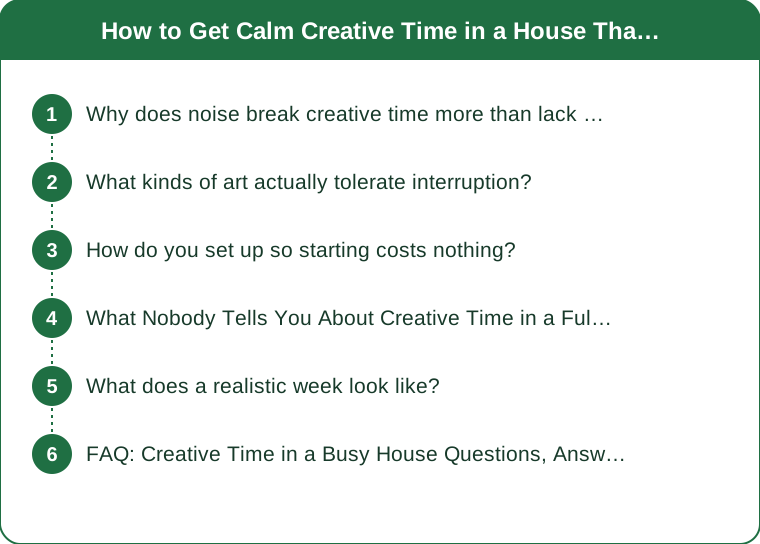
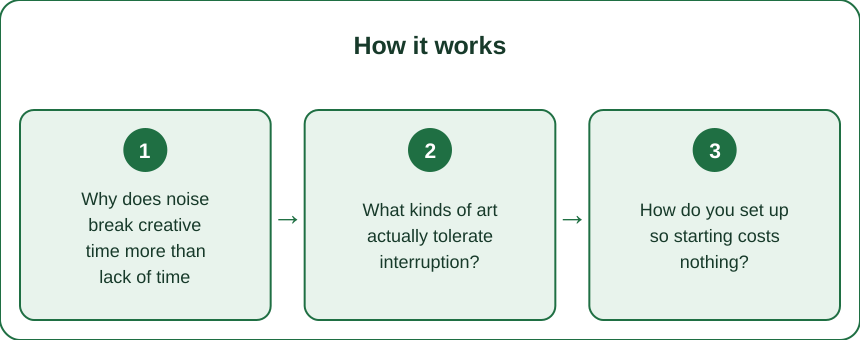
Why does noise break creative time more than lack of time does?
Because most creative activities as usually described require sustained attention, and interruption costs more than the interrupted minutes.
After a break in concentration, it takes a while to get back into a task - the switching cost is real and it applies to a drawing as much as to spreadsheet work. A 30-minute window with four interruptions is not 30 minutes of practice; it can end up as four abandoned starts and a feeling of failure.
There is a second, quieter problem: anticipating interruption is itself distracting. If you know someone will need you in ten minutes, part of your attention is monitoring for it. That monitoring is the opposite of the absorbed state that makes creative time calming.
So the standard approach fails in two ways at once:
- The activity chosen requires uninterrupted flow to be satisfying
- The expectation set is a protected block, which the household will not provide
The fix is not to fight for silence. It is to choose work that survives interruption and to stop measuring success by uninterrupted minutes.
Which also means the goal changes. Not an hour of flow, but five minutes of doing something with your hands that you can walk away from mid-line.
What kinds of art actually tolerate interruption?
Some activities resume gracefully. Others require you to hold a plan in your head, and those are the ones that feel ruined when someone shouts from another room.
Good for a loud house - resumable, low-plan work:
- Repetitive pattern work. Zentangle-style filling, hatching, dot work. You can stop mid-pattern and continue with no loss, because the next mark is obvious.
- Contour and blind contour drawing. One continuous line following an edge. Put it down, pick it up, keep going.
- Colour swatching and palette pages. Mixing and recording colours in small squares. Genuinely satisfying and completely interruptible.
- Small-format work. A postcard-sized piece finished in one sitting beats a large piece requiring six sessions you will not get.
- Collage. Cutting and sorting is calming, requires no fine control, and pauses perfectly.
Poor for a loud house - plan-heavy, precision work:
- Wet-in-wet watercolour, where timing controls the outcome and a five-minute interruption changes the paper
- Detailed observational drawing, which needs sustained comparison between subject and page
- Anything with a drying window you must return to at a specific moment
This is not a permanent restriction. It is what fits the life you currently have, and pattern work done four times a week builds far more skill than detailed drawing attempted twice a month.
How do you set up so starting costs nothing?
The single biggest barrier in a busy house is setup and pack-away. If a session costs five minutes of preparation, an eleven-minute gap is not usable.
Keep it permanently out. One A5 sketchbook and one pen, on the kitchen table or the arm of the sofa. Not in a drawer. Not in a bag. Visible and open if possible.
Use one tool, not a kit. A single fineliner or a single pencil removes all decision-making. Choosing between materials is a surprisingly effective way to never start.
Make a second station. A small pouch with a pen and a folded piece of paper in your bag or coat means a waiting-room ten minutes becomes usable.
Leave the page open at your current piece. A closed sketchbook requires a decision about what to do; an open page with a half-finished pattern requires only continuing.
Accept a shared, imperfect surface. The kitchen table with someone else’s things on it is a workable studio. Waiting for a clear dedicated space is waiting for a different life.
And drop the setup ritual. The candle, the tidy desk, the right playlist - all pleasant, all barriers. Ritual is what you build when you have hours. When you have minutes, you need zero-friction access and nothing else.

What Nobody Tells You About Creative Time in a Full House
Headphones with familiar music beat silence. Silence is not available, and trying to create it produces frustration. Noise-cancelling headphones with music you know well - familiar enough that you do not attend to it - creates a portable envelope that works at a kitchen table with a television on.
Being visible can help rather than hurt. Drawing at the kitchen table where everyone can see you often produces fewer interruptions than shutting yourself in a room, because a closed door reads as an invitation to knock. It also normalises the habit for the household, and children who see an adult drawing often start drawing alongside rather than interrupting.
Parallel play is a legitimate solution. Sitting with a child who is colouring while you sketch is not a compromised version of your practice. It is often the most reliable slot in the week, and the presence of someone else working quietly is close to body doubling.
Interrupted work looks different, and that is fine. A page built in six two-minute fragments has a fragmented quality that a single sitting does not. It is a style rather than a failure, and it is visibly the record of a real life.
Five minutes daily beats an hour weekly for calm, though not for output. If the reason you do this is stress rather than a portfolio, frequency is the variable that matters. The nervous-system benefit comes from regular short doses, not from occasional long ones.
The five-minute session usually extends itself. Most people who sit down for five minutes with something already open stay for fifteen. The five-minute framing is what gets you into the chair - it does not have to be what you do.
What does a realistic week look like?
No protected hour, no dedicated room. Just slots that already exist.
The reliable slots most households actually contain:
- First ten minutes of the morning, before anyone else is up
- While something cooks - a pattern page while the oven does its work
- Alongside a child’s activity - homework, colouring, a screen half-hour
- The waiting slots - school pickup, an appointment, a train
- The last ten minutes before bed, instead of a phone
Pick two. Not five. Two named slots that genuinely exist in your week, and put the sketchbook where those slots happen.
Set a floor, not a target. The floor is one mark on the page. Some days that is all you do, and it counts, because the purpose of the floor is to keep the habit alive on bad days rather than to produce work.
Track it minimally. A dot in the corner of each page you touch. Not a habit app, not a streak you can break - just evidence.
Expect the pattern to shift. Slots that work in term time collapse in holidays. Rather than concluding the habit failed, re-pick two slots for the new shape of the week. This is maintenance, not restarting.
And separate calm from progress. If you want to develop skill, that needs longer focused sessions and you may need to negotiate for them occasionally. If you want the calming effect, short and frequent in a noisy kitchen delivers it perfectly well - and it is available today.
FAQ: Creative Time in a Busy House Questions, Answered
Is five minutes really long enough to feel any benefit?
For the calming effect, yes - short repetitive hand work has a settling quality that shows up quickly. For skill development you eventually want longer sessions, but five minutes daily builds more skill over a month than an hour you keep postponing.
How do I stop feeling guilty about taking the time?
It helps to make it visible and small. Five minutes at the kitchen table is hard for anyone to object to, including yourself, and doing it in the open rather than behind a door removes the sense that you are taking something from the household.
What if my children want to join in?
Let them, and keep your own page separate. Parallel work is one of the most reliable slots available, and it removes the interruption problem entirely because they are occupied doing the same thing.
Should I use headphones if I need to hear what is happening?
Use one earbud, or low-volume open headphones. The point is a consistent sound layer over unpredictable noise, not full isolation - especially if you are the person who needs to hear a child.
TL;DR:
- Interruption cost, not total time, is what breaks creative practice in a busy house
- Choose resumable work: pattern filling, contour lines, colour swatches, collage, small formats
- Keep one sketchbook and one pen permanently out and open - setup cost kills short sessions
- Familiar music through headphones works better than trying to create silence
- Pick two slots that already exist, set the floor at one mark, and re-pick when the week changes
The quiet studio version of this hobby is not the real version - it is the photographed version. A pen on a cluttered kitchen table, five minutes at a time, four days a week, delivers almost all of the calm and none of the waiting.
Keep Reading
This article is for general informational and styling purposes only. Fit, sizing, and product availability may vary.