Why Drawing From Life Calms You More Than Drawing From a Photo
Quick Answer: Drawing from life demands continuous observation - your eyes move, judge, and correct constantly - which occupies attention fully and leaves little capacity for rumination. Drawing from a photo lets you copy a fixed, already-flattened image, which is a lower-attention task that the mind can wander during. If you draw specifically to feel calmer, work from something physically in front of you, even something as ordinary as a mug.
The difference is not about which produces a better drawing. It is about which occupies more of your head while you do it.
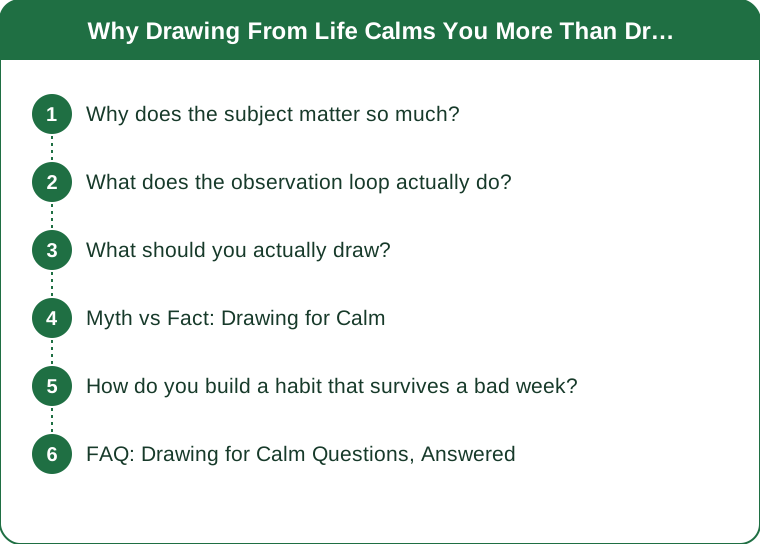
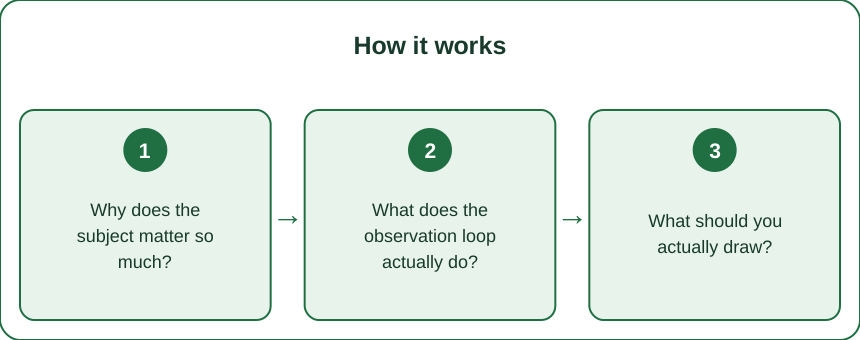
Why does the subject matter so much?
Because calm from drawing comes from attentional absorption, and the two tasks demand very different amounts of attention.
When you draw from life, you are constantly solving problems: how does this edge relate to that one, how far apart are these two points, is this angle steeper than it looks, what happened when I moved my head slightly. Your eyes leave the page and return dozens of times a minute, and each return requires a fresh judgement.
When you draw from a photo, most of that work is already done. The three-dimensional scene has been flattened, the edges are fixed, the tones are set, and the relationships hold still. You are transcribing rather than translating.
Transcription is a lower-demand task, which means there is spare attention available - and spare attention is exactly what rumination fills. This is why people sometimes report finishing a photo-based drawing having spent the whole time worrying about something else, then wondering why it did not help.
None of this makes photo reference bad. It makes it a different tool, better suited to learning technique, working on something you cannot access, or drawing when you want a lower-demand activity.
What does the observation loop actually do?
It creates a rapid, repeating cycle that is hard to hold anything else inside.
The cycle is: look, judge, mark, compare, correct. It runs continuously and each pass takes a second or two. There is no natural gap in it - the moment you finish one mark, the next judgement is waiting.
This has two effects. First, it is genuinely absorbing in the way people describe as flow, and flow states are consistently associated with reduced self-referential thinking. Second, it is externally anchored. Your attention is on an object in the room, not on your own thoughts, which is much the same mechanism as several common grounding techniques.
There is also a physical component that gets overlooked. Drawing from life involves small head movements, changes in focal distance as your eyes shift between the subject and the page, and postural micro-adjustments. Eye movement between near and far distances is itself relaxing for many people, and it does not happen when the reference is a screen at the same distance as your paper.
A phone as reference is the worst case: fixed focal distance, plus a device that can interrupt you.
What should you actually draw?
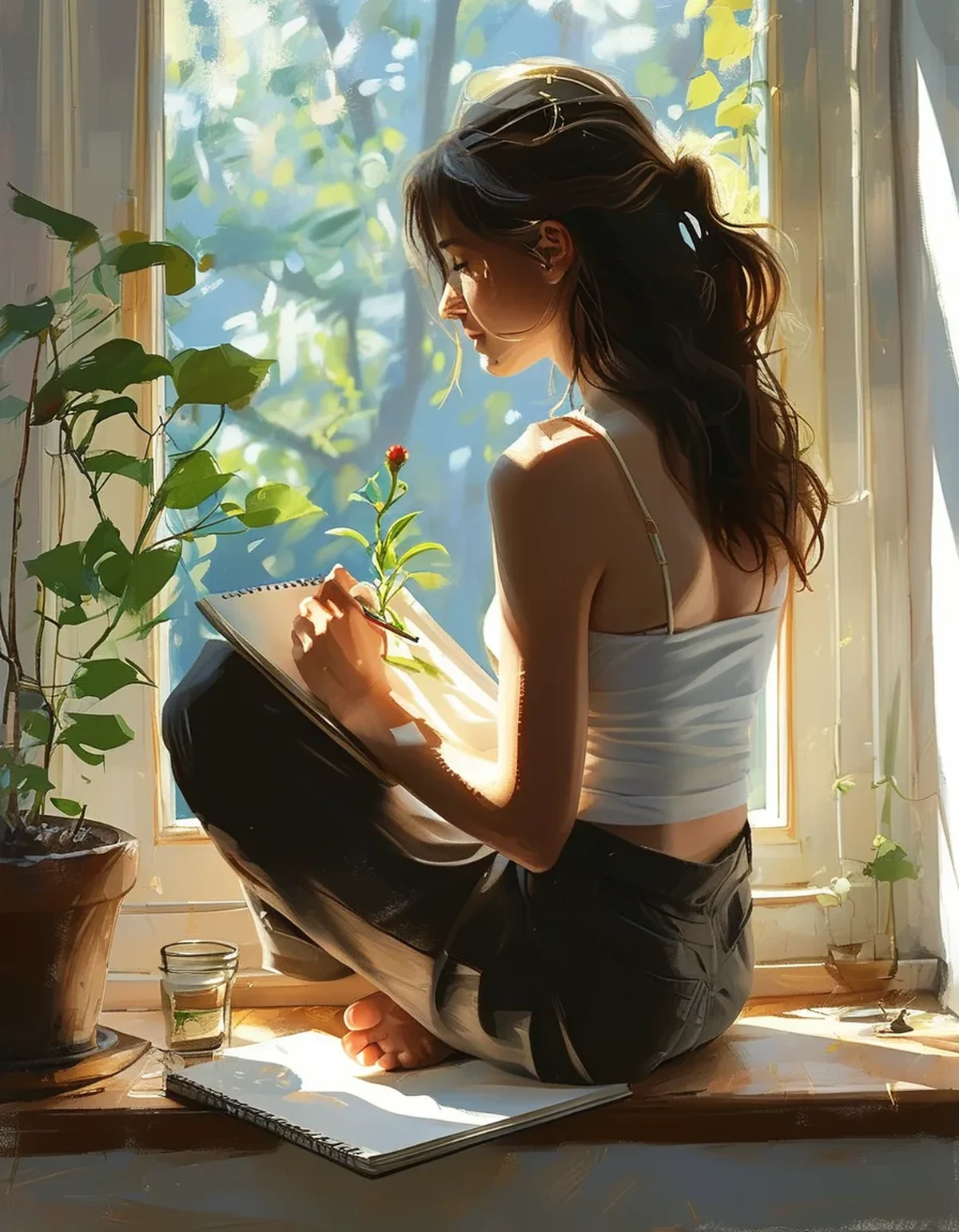
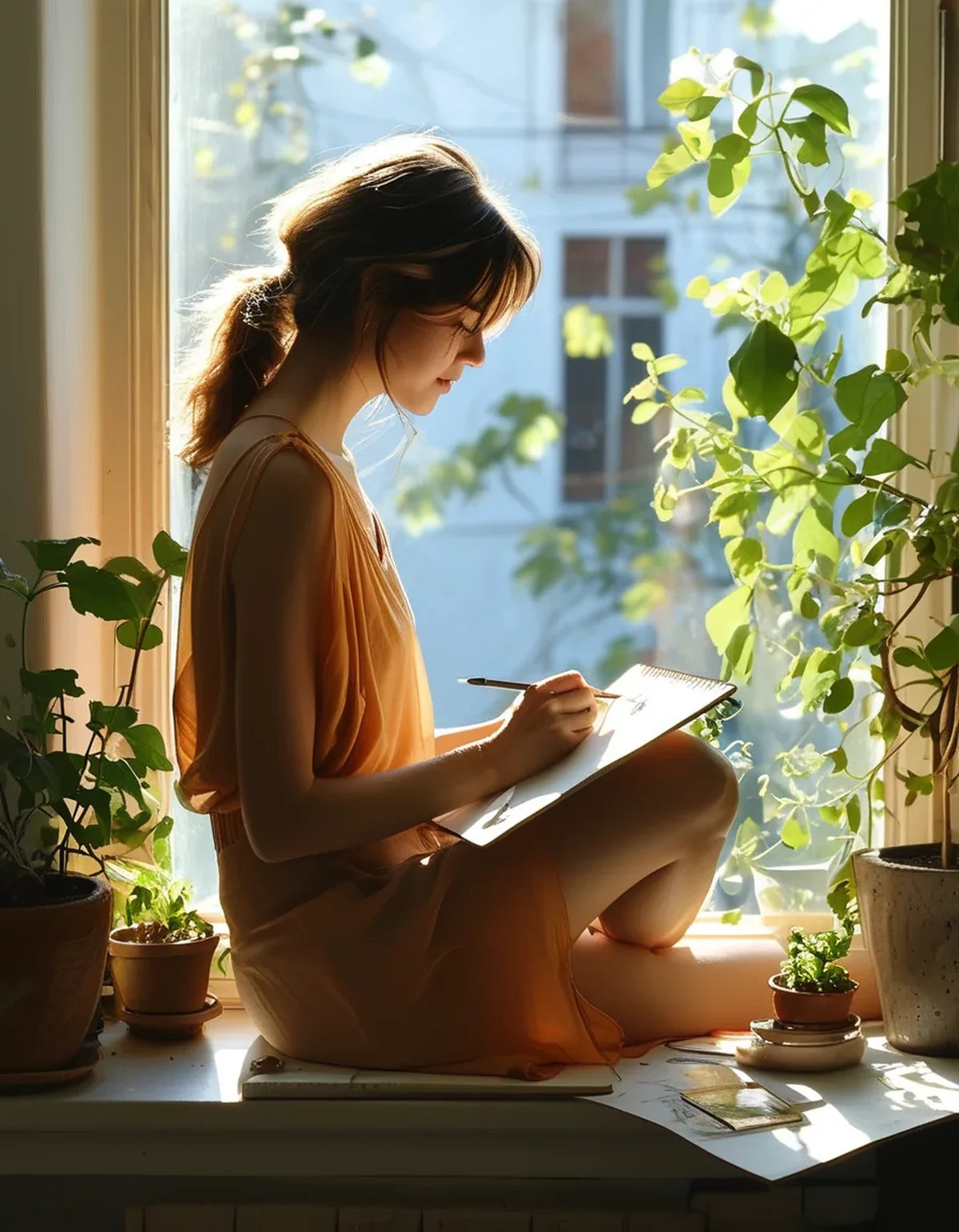
The lowest-stakes subject you can find, in the room you are already in. Ambition is the enemy here.
Excellent subjects for calm:
- A single plant or leaf. Complex enough to hold attention, forgiving of error, and no one can tell whether you got it right.
- A mug, a bottle, a pair of scissors. Ordinary objects with clear edges. The banality is the point - nothing at stake.
- A crumpled piece of paper. Genuinely absorbing, endlessly detailed, and impossible to draw wrong.
- The view through a window, drawn as shapes rather than as a landscape.
- Your own hand. Always available, and the shifting position keeps the observation demand high.
Poor subjects for calm: faces of people you know, anything you intend to give someone, anything you have tried and failed at before, and anything where you will be able to judge accuracy easily. The moment accuracy becomes measurable, the task stops being observation and starts being performance.
This is also why a plant beats a portrait. Nobody looks at a drawn leaf and says the proportions are off.
Myth vs Fact: Drawing for Calm
Myth: You need to be able to draw for this to work. Fact: The calming mechanism is the observation loop, which is available to a complete beginner. Skill affects the outcome on the page and has very little to do with the effect on your head.
Myth: Longer sessions are better. Fact: Attention degrades. Twenty focused minutes usually does more than ninety distracted ones, and short frequent sessions build a sustainable habit far better than occasional long ones.
Myth: Colouring books and drawing do the same thing. Fact: They overlap but differ. Colouring is repetitive, structured, and low-decision, which suits high-anxiety moments when observation feels like too much. Drawing from life is higher-demand and more absorbing when you have the capacity for it. Both are useful; they suit different states.
Myth: Digital drawing works the same way. Fact: The observation loop still exists if you are drawing from life onto a tablet. What changes is the device - notifications, the undo button, and the fixed focal distance all reduce absorption. The undo button in particular changes the psychology, since permanence is part of what forces genuine attention.
Myth: You should keep and improve on your drawings. Fact: For calm specifically, treating them as disposable removes the performance pressure that undermines the whole thing. A sketchbook you never show anyone is doing its job.
How do you build a habit that survives a bad week?
Small, fixed, and visible. The failure mode is always ambition, not laziness.
Keep the materials out. A sketchbook and one pencil on the table where you sit, permanently. A kit in a drawer is a kit you use twice. This single change does more for consistency than any amount of intention.
Set a floor, not a target. Ten minutes, or one object. A floor small enough to clear on your worst day means the habit survives bad weeks, and bad weeks are when you most want it.
Attach it to something existing. After the evening meal, after closing the laptop, with the first coffee. A fixed trigger beats a reminder.
Use one pen rather than a set. Choice is friction, and a permanent medium removes the erasing loop that turns drawing back into performance.
Do not photograph them. The moment a drawing exists to be shown, the observation loop competes with a self-assessment loop, and the self-assessment loop is exactly the thinking you were trying to quiet.
When you genuinely cannot face observation - a high-anxiety day, real exhaustion - drop to something more mechanical. Cross-hatching a square, filling a page with repeated marks, colouring. Those days need lower demand, not more discipline. If low mood or anxiety is persistent or interfering with daily life, it is worth talking to a professional. This is general information, not medical advice.
FAQ: Drawing for Calm Questions, Answered
How long does a session need to be?
Ten to twenty minutes is enough for most people to notice a shift. The absorption tends to build over the first few minutes, so very short sessions under five minutes often end before the effect starts.
Is it worth taking a class?
For skill, yes. For calm specifically, a class adds observation by others and a performance element, which can work against the effect at first. Many people do both, keeping a private practice separate from a learning one.
What if I hate everything I draw?
That reaction is a self-assessment loop, and it is common. Try drawing something with no correct answer - crumpled paper, tangled cable, a shadow shape. When accuracy cannot be judged, the critic has nothing to grip.
Does the medium matter?
Less than the subject. Pencil, pen, and charcoal all work. A permanent medium slightly helps by removing the erase-and-retry loop, which is where perfectionism tends to enter.
Can I do this outdoors?
Yes, and many people find it stronger outdoors - more visual complexity, changing light, and greater distance between near and far focus. A small sketchbook and one pen in a bag makes it possible anywhere.
TL;DR:
- Drawing from life demands continuous observation, which fills attention and crowds out rumination
- Drawing from a photo is transcription - a lower-demand task the mind can wander during
- Choose banal, low-stakes subjects where accuracy cannot be judged: plants, mugs, crumpled paper
- Keep materials out, set a floor of ten minutes, use one pen, do not photograph the results
- On very low-capacity days, drop to repetitive mark-making rather than pushing for observation
The thing that calms you is not the drawing. It is the looking, and looking at a real object in the room demands far more of you than looking at a picture of one. Put a plant in front of you and draw it badly - the badness is irrelevant to the part that works. This is general information, not medical advice.
Keep Reading
This article is for general informational and styling purposes only. Fit, sizing, and product availability may vary.