What to Draw When You Cannot Concentrate on Anything
Quick Answer: On low-focus days, choose drawing that removes decisions rather than requiring them - repetitive mark-making, tracing shapes you can see, filling a grid, or copying something simple line by line. The goal is occupied hands and a lowered demand on the part of your brain that is not cooperating, not a good drawing at the end.
The advice for creative blocks usually assumes you have focus and lack ideas. Some days it is the reverse: you know exactly what you would like to draw and you cannot hold your attention on it for ninety seconds.

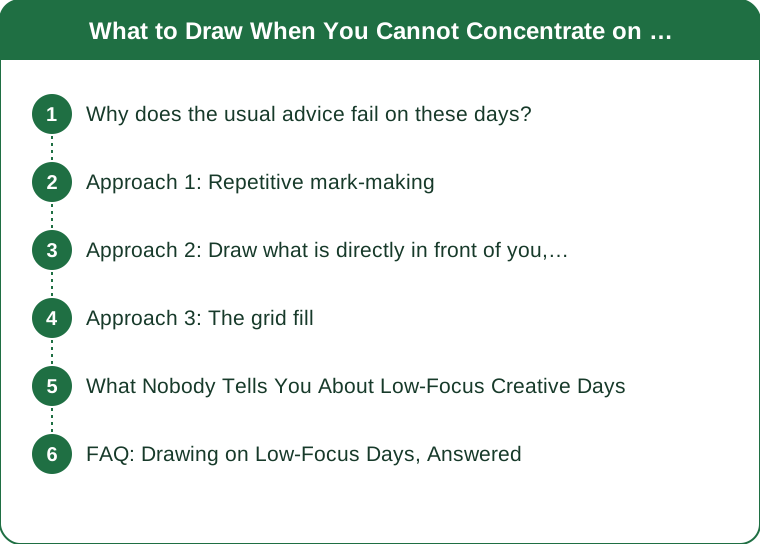
Why does the usual advice fail on these days?
Because most drawing advice assumes the bottleneck is motivation or ideas, and on a low-focus day the bottleneck is decision-making capacity.
A blank page requires an enormous number of small decisions before a single mark exists: what to draw, where to start, how large, in what medium, from what angle. Each is trivial in isolation. Together they form a barrier that a tired or restless mind cannot easily cross.
This is why just start drawing anything is unhelpful advice on exactly the days you need it. The word “anything” is the problem - unlimited choice is the heaviest possible demand.
It also explains a pattern people find confusing: you can happily colour in something for forty minutes, but cannot manage ten minutes of your own drawing. Colouring removed the decisions. The activity is not less demanding physically; it is less demanding in the specific way that matters that day.
So the design principle for low-focus days is: remove decisions, keep the hands busy. Everything below is a variation on that.
The secondary benefit is that these sessions often unlock a normal one. Twenty minutes of undemanding mark-making frequently ends with you wanting to draw something properly - but that is a bonus rather than the aim, and treating it as the aim reintroduces the pressure you were avoiding.
Approach 1: Repetitive mark-making
The lowest-demand option, and the one that works when nothing else does.
What it is: filling an area with a single repeated mark. Not drawing anything. Hatching, stippling, small circles, waves, or a continuous spiral that fills the page.
How to do it:
- Draw a simple boundary - a rectangle, or just the page edge
- Choose one mark and repeat it until the space is full
- No planning, no variation unless it happens naturally
- 10 to 20 minutes is plenty
Why it works: the decision count is one, made at the start. After that the activity is entirely motor, which occupies the hands and eyes without asking anything of the planning part of your brain.
Variations worth having:
- Gradient hatching - marks gradually closer together across the page, which adds a mild goal without adding decisions
- Filling a shape you have drawn around a coin or a cup
- Repeating a small motif across a grid
The output is not the point, and this is where people get stuck. A page of stippling is not a drawing and does not need to be. It is twenty minutes of hands-busy attention, which on a bad day is a genuinely good outcome.
Approach 2: Draw what is directly in front of you, badly
The constraint that makes this work is the word badly - and it has to be an actual permission, not a joke.
How to do it: pick the nearest object. A mug, a shoe, a plant. Draw it in under three minutes with no erasing. Then draw the same object again, still under three minutes. Then a third time.
Why repetition of the same object helps: the decision of what to draw is made once and reused. The second and third attempts also arrive with the anxiety mostly gone, because you already have a bad one on the page and nothing worse can happen.
The no-erasing rule matters. Erasing is a decision loop, and decision loops are what you are avoiding. Wrong lines stay, and the drawing gets a sketchy quality that is often more alive than a careful one.
Set a timer. An open-ended session on a low-focus day drifts. Three minutes is short enough that starting feels trivial.
If three drawings feel like enough, stop. Nine minutes of drawing on a day when you thought you could not draw at all is a good session and should be recorded as one.

Approach 3: The grid fill
Structure with almost no creative demand, and it produces something that looks intentional at the end.
How to do it:
- Draw a grid - 4 by 4 squares on an A5 page is a good size
- Fill each square with a different simple pattern: stripes, dots, checks, waves, spirals, crosshatch
- One square at a time, no plan for the whole page
Why it works so well on bad days: each square is a tiny, self-contained task with a visible end point. You get sixteen small completions instead of one large uncertain one. Completion is the thing in short supply on a low-focus day, and this manufactures it.
Variations:
- One colour per row, if you want something less monochrome
- Squares of different sizes, which adds visual interest without adding decisions
- Copy patterns from around the room - fabric weave, tile, a book cover
Stopping partway is fine. A half-filled grid is a legitimate stopping point, unlike a half-finished portrait. That property alone makes it one of the most forgiving formats there is.
What Nobody Tells You About Low-Focus Creative Days
The sketchbook itself can be the obstacle. A nice sketchbook carries an implicit standard, and on a low-focus day that standard is enough to prevent starting. Keep cheap paper - printer paper, the back of an envelope, a notebook you do not care about - specifically for these days. The permission is in the material.
Materials with fewer options are easier. A single pencil beats a set of forty pencils, because the set requires a choice before every mark. On difficult days, take one tool out and put the rest away.
Physical state is often the actual variable. Low focus frequently tracks with poor sleep, being hungry, dehydration, or having been indoors all day. It is worth a two-minute check before concluding it is a creative problem: water, food, and ten minutes outside resolve a surprising proportion of unfocused afternoons.
Background noise helps some people considerably. Music without lyrics, a podcast you have already heard, or ambient noise occupies the part of the mind that is generating restlessness. Silence is not universally better for concentration and for some people is distinctly worse.
Duration expectations are usually the problem. People plan an hour, manage eight minutes, and count it as a failure. Plan ten minutes. Ten minutes done is a success and often becomes thirty, whereas an hour planned and abandoned at eight minutes feels like proof of something discouraging.
These days are not wasted practice. Repetitive mark-making builds line control and hand steadiness. Fast bad drawings build observational speed. The skill development is real even when the output is not something you would show anyone.
FAQ: Drawing on Low-Focus Days, Answered
Is it better to push through or stop entirely?
Neither, usually. Lowering the demand is the third option and generally the most productive - swap the ambitious project for repetitive mark-making rather than choosing between forcing it and abandoning the day.
Does this count as real practice?
Yes, for the specific skills involved. Mark-making improves control and consistency, and rapid observational sketches improve seeing. It is not composition or project practice, but it is not nothing.
What if I cannot even start the low-demand version?
Make it smaller. Draw one square inch of pattern. Set a two-minute timer. If that still does not happen, the issue is likely not the drawing, and a walk or a nap will serve you better than any technique here.
Should I keep these pages or throw them out?
Keep them, at least for a while. Looking back at a run of low-focus pages over months is often surprisingly encouraging - the mark quality visibly improves, and it is evidence of continuity through periods you remember as unproductive.
Does drawing actually help with anxiety or restlessness?
Repetitive, absorbing manual activity is widely reported as calming and there is reasonable interest in it in research on focused attention. It is not a treatment for a clinical condition, and persistent difficulty concentrating is worth discussing with a professional. This is general information, not medical advice.
TL;DR:
- Low-focus days are a decision-capacity problem, not a motivation problem - so remove decisions
- Repetitive mark-making, three-minute repeated sketches of one object, and grid fills all work
- No erasing, one tool out, cheap paper, and a timer set short
- A half-finished grid is a legitimate stopping point; a half-finished portrait is not
- Plan ten minutes rather than an hour, and check water, food, and daylight first
The sessions that keep a drawing habit alive are not the good ones. They are the ones on the days you almost did not, which is exactly why they should be as easy to start as possible.
Keep Reading
This article is for general informational and styling purposes only. Fit, sizing, and product availability may vary.