Why Your 5-Minute Sketch Habit Keeps Falling Apart (And What Actually Makes It Stick)
Quick Answer: Most 5-minute sketch habits fall apart not because 5 minutes is too little time, but because there’s no fixed trigger cue tying the habit to an existing routine — pairing it to something you already do daily (like morning coffee) fixes this far more reliably than willpower.
You’ve started this habit three separate times. Week one feels great. By week three, days start slipping, and by week five it’s quietly gone, just like the last two attempts.

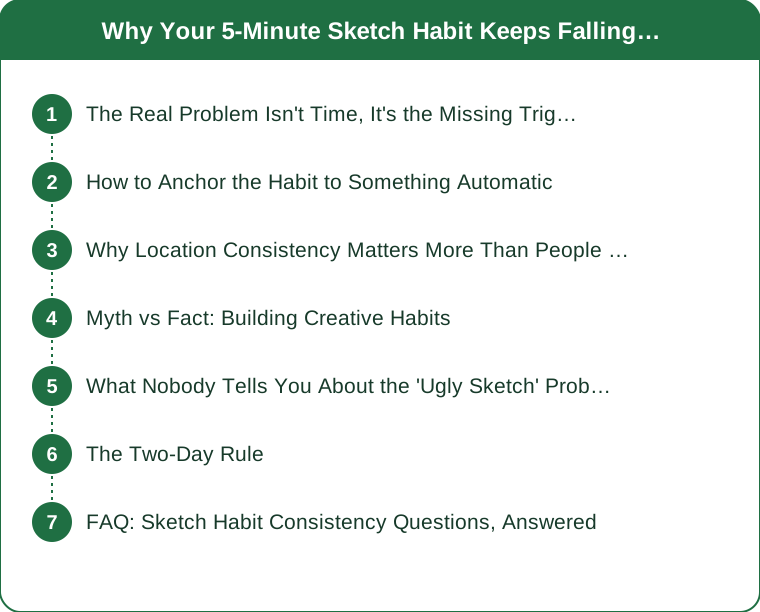
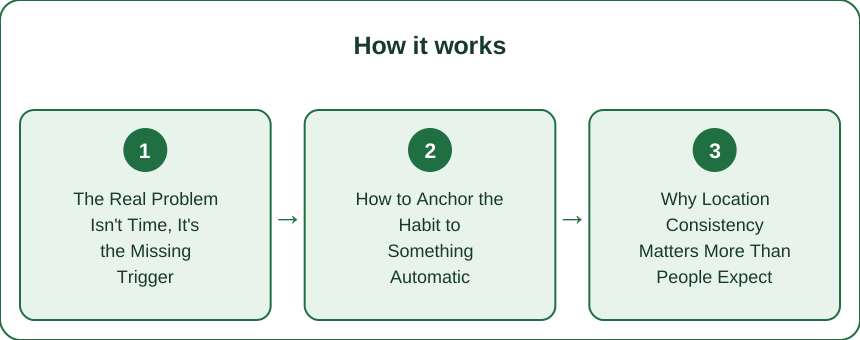
The Real Problem Isn’t Time, It’s the Missing Trigger
Five minutes is genuinely a small enough time commitment that ‘no time’ is rarely the true reason it fails. The actual failure point is usually that the habit floats freely in your day with no fixed cue — ‘sometime today’ quietly becomes ‘not today’ more often than people expect.
How to Anchor the Habit to Something Automatic
Pick an existing daily habit you never skip — morning coffee, brushing teeth, sitting down at your desk — and place the sketch habit immediately before or after it, in the same physical location every time. The existing habit becomes the trigger, removing the need to remember or decide.
Why Location Consistency Matters More Than People Expect
Keeping your sketchbook in one fixed, visible spot (not tucked in a drawer) removes a small but real friction point — every extra step between deciding to sketch and actually starting is a chance for the habit to get skipped that day.

Myth vs Fact: Building Creative Habits
Myth: You need to feel inspired to sketch consistently. Fact: habit consistency and inspiration are largely unrelated — showing up without inspiration, even for a rough scribble, is what actually builds the habit loop over time.
Myth: Missing a day ruins the habit. Fact: research on habit formation shows an occasional missed day has minimal impact on long-term habit strength, but missing two days in a row meaningfully increases the risk of the habit fully lapsing.
What Nobody Tells You About the ‘Ugly Sketch’ Problem
Many people quietly quit not because they forgot, but because a string of sketches they didn’t like made the habit feel unrewarding. Lowering the bar explicitly — some days genuinely are just a few lines, and that still counts as a full success — removes the perfectionism trap that kills far more habits than forgetfulness does.
The Two-Day Rule
If you miss one day, treat it as nothing — don’t double up the next day to ‘make up for it,’ which just adds pressure. If you’re about to miss a second consecutive day, that’s the moment to actively intervene (even a 60-second version counts) since two misses in a row is the real danger zone for the habit fully dissolving.
FAQ: Sketch Habit Consistency Questions, Answered
What if 5 minutes still feels like too much some days?
Drop to a genuine 60-second version on hard days rather than skipping entirely — maintaining the trigger and location matters more than the duration on any single day.
Does it matter what I sketch?
No — the habit-building mechanism cares about consistency and the physical act, not subject matter or quality, especially in the first 4-6 weeks.
How long until it feels automatic?
Most habit research suggests somewhere between 3-8 weeks of consistent repetition before a new habit starts feeling automatic rather than effortful, varying a lot by person.
TL;DR:
- The habit rarely fails from lack of time — it fails from lacking a fixed trigger cue
- Anchor it immediately before/after an existing daily habit, same spot every time
- Missing one day is fine; missing two in a row is the real risk point
- Lower the bar on hard days (60 seconds counts) rather than skipping
A sketch habit that keeps dissolving after a few weeks usually has a structural problem, not a willpower problem — fix the trigger and location before assuming you’re just not a ‘habit person.’
Keep Reading
This article is for general informational and styling purposes only. Fit, sizing, and product availability may vary.