Why Your 5-Minute Sketch Habit Keeps Not Sticking (and What Actually Fixes It)
Quick Answer: Most 5-minute sketch habits fail not from lack of time but from an unclear starting point each day — deciding what to draw becomes its own barrier; fixing this with a simple rotating prompt list removes the decision fatigue that quietly kills the habit.
You committed to 5 minutes of daily sketching, genuinely have the time, and still stopped after 9 days. The time was never the problem — the blank page and the ‘what do I even draw’ moment usually is.

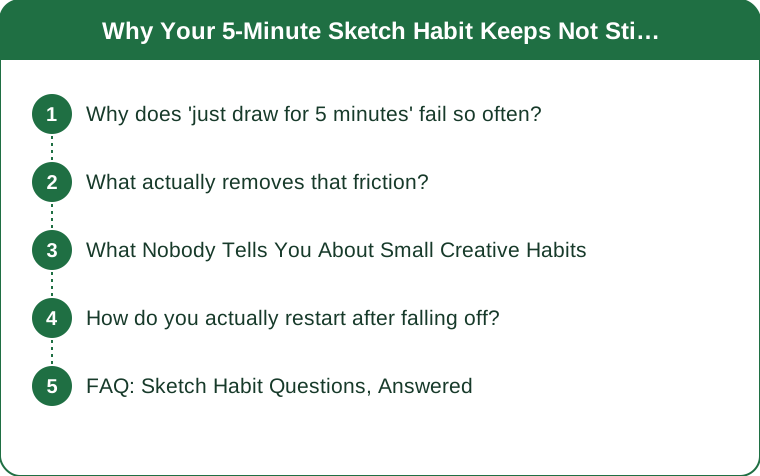
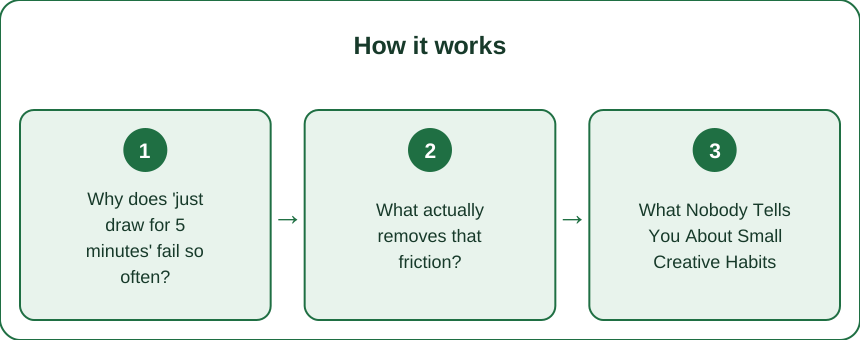
Why does ‘just draw for 5 minutes’ fail so often?
Because it leaves a decision unmade: what to draw. That small, seemingly trivial choice is actually a form of decision fatigue, and facing it fresh every single day is enough friction to make people skip ‘just this once’ — which becomes twice, then the habit is gone.
Habits that stick tend to remove decisions, not add them. ‘Sketch for 5 minutes’ sounds simple but secretly asks you to also be a creative director every day, which is a bigger ask than it appears.
What actually removes that friction?
A pre-made rotating prompt list — 30 simple prompts (a mug, your hand, a shoe, a plant, a chair) written out in advance, worked through in order or picked randomly. When you sit down, there’s no decision left except to start drawing.
This single change is disproportionately effective for habit adherence compared to almost any other adjustment — removing the ‘what do I draw’ question is often the difference between a habit that lasts 2 weeks and one that lasts 6 months.

What Nobody Tells You About Small Creative Habits
Quality expectations quietly kill more habits than lack of time does. If day 4’s sketch looks worse than day 1’s (completely normal — skill isn’t linear day to day), many people interpret that as ‘this isn’t working’ and quietly stop, when it’s actually just how skill development looks up close.
Also underrated: keeping the sketches somewhere visible, even a cheap notebook you flip through occasionally, rather than loose paper that gets lost or thrown away. Seeing genuine progress over a month — not day to day, but week to week — is what sustains motivation once the initial novelty fades.
How do you actually restart after falling off?
Restart at 5 minutes, not lower, not higher — dropping to ‘2 minutes to make it easier’ or jumping back to 15 minutes ‘to make up for lost time’ both undermine the simple, repeatable structure that made this workable in the first place.
Don’t try to make up missed days — a habit tracker showing a broken streak can itself become discouraging; the useful metric is total days this month, not a consecutive streak that resets your motivation to zero the moment it breaks.
FAQ: Sketch Habit Questions, Answered
How long does it take for a 5-minute sketch habit to actually feel automatic?
Most habit research suggests somewhere in the range of 2-3 months of reasonably consistent practice before it stops requiring conscious effort to start.
Should I use a timer for the 5 minutes?
Yes — a visible timer removes the ambiguous ‘is this done yet’ question and makes the commitment feel more concrete and finite, which lowers the barrier to starting.
What if I genuinely have no time some days?
A 60-second version (even just a few lines) on those days preserves the habit’s continuity better than skipping entirely — showing up briefly beats not showing up at all.
TL;DR:
- The habit usually fails from decision fatigue (what to draw), not lack of time
- A pre-made rotating prompt list removes that daily decision entirely
- Quality dips are normal skill variation, not a sign the habit ‘isn’t working’
- Track total days per month, not consecutive streaks, and restart at 5 minutes after a break
Remove the decision, not the time commitment, and this kind of habit gets much easier to keep.
Keep Reading
This article is for general informational and styling purposes only. Fit, sizing, and product availability may vary.