The Only 3 Art Supplies That Matter for Starting a Calm Sketch Habit
Quick Answer: A pencil you like the feel of, a small notebook that lives somewhere visible, and nothing else. Extra supplies add decision fatigue before you’ve even started drawing, and that friction is often what kills a new habit in week one.
Art supply stores make it look like you need 40 items to start sketching. The habit that actually sticks usually starts with three things — sometimes fewer — kept somewhere you’ll actually see them every day.

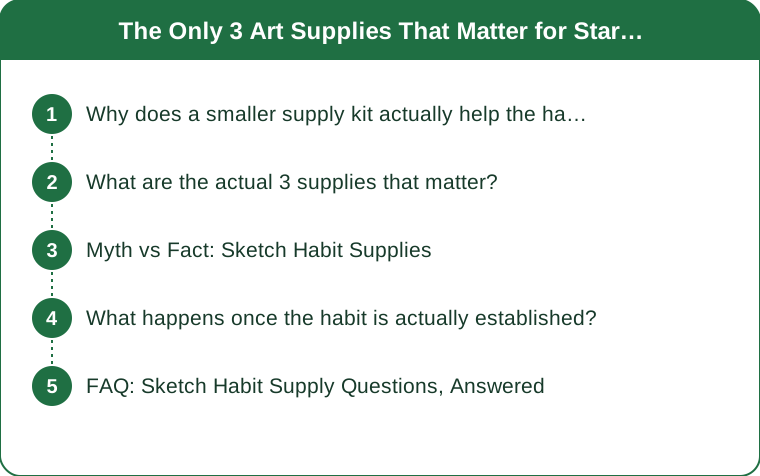
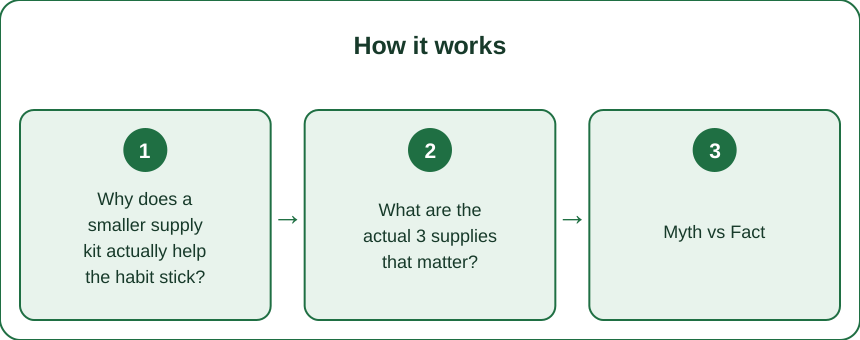
Why does a smaller supply kit actually help the habit stick?
Every extra choice — which pencil, which paper, which reference — is a small decision that has to happen before you draw a single line. For a habit you’re trying to build in low-motivation moments, each of those decisions is a place the habit can quietly die before it starts.
A fixed, minimal kit removes the decision entirely: you pick up the one pencil and the one notebook, every time, no choosing required.
What are the actual 3 supplies that matter?
1. One pencil you genuinely like the feel of — not the “correct” grade, just one that feels good in your hand, since that removes any hesitation about which pencil to grab.
2. A small notebook, not a large sketchbook — small feels lower-stakes, which matters enormously for a habit still fragile enough to be killed by perfectionism.
3. Visibility, not a supply at all but a placement decision — the notebook and pencil live somewhere you pass daily (kitchen counter, bedside table), not in a drawer.

Myth vs Fact: Sketch Habit Supplies
Myth: Better supplies produce better habit consistency. Fact: Supply quality has little correlation with habit consistency — visibility and low friction predict consistency far better than pencil grade or paper quality.
Myth: You need reference photos or prompts to know what to draw. Fact: For a calm, habit-building sketch practice, drawing whatever’s nearby (a coffee cup, your own hand) removes another decision point and works just as well for the stress-relief goal.
Myth: A bigger sketchbook lets you do “real” art. Fact: A small notebook actually protects the habit better — big blank pages can feel intimidating in a way that stalls beginners before they start.
What happens once the habit is actually established?
After the habit is genuinely automatic — typically 4-8 weeks of near-daily use — that’s the right time to expand supplies if you want to, since decision fatigue matters far less once the core behavior (picking up pencil and notebook) no longer requires willpower.
Adding supplies too early is the more common mistake than adding them too late.
FAQ: Sketch Habit Supply Questions, Answered
Do I need good drawing skill to start this habit?
No — the habit is about the daily practice and stress-relief benefit, not the output quality. Most calm-sketch practices explicitly aren’t about the final drawing.
What if I lose interest in the same pencil and notebook after a few weeks?
That’s a sign the habit itself has taken hold — feel free to introduce variety at that point without risking the whole habit collapsing.
Should the notebook have lines, grids, or be blank?
Blank is generally recommended for sketching specifically — lines and grids are built for writing and can subtly discourage free drawing.
TL;DR:
- One pencil, one small notebook, kept somewhere visible — that’s the whole kit
- Fewer choices means less friction between “I should sketch” and actually doing it
- A small notebook lowers the stakes more than a big sketchbook
- Expand supplies only after the habit is genuinely automatic, usually 4-8 weeks in
Keep Reading
This article is for general informational and styling purposes only. Fit, sizing, and product availability may vary.