The Blank Page Is Not the Problem: Drawing Past Perfectionism
Quick Answer: Creative paralysis in front of a blank page is not a talent shortage - it is your brain treating a possible bad drawing as a threat to your identity, so it protects you by preventing the attempt. The fix is lowering the stakes structurally: a designated warm-up page you are required to ruin, cheap materials, pen instead of pencil, quantity quotas instead of quality goals, and ending sessions mid-drawing so re-entry is easy. Perfectionism starves when nothing is precious.
The supplies are lovely, the tutorial is bookmarked, the twenty free minutes finally arrived - and you tidy the kitchen instead. Again. The problem was never discipline. It is that some part of you has decided a bad drawing means something about you, and it is quietly protecting you from finding out.

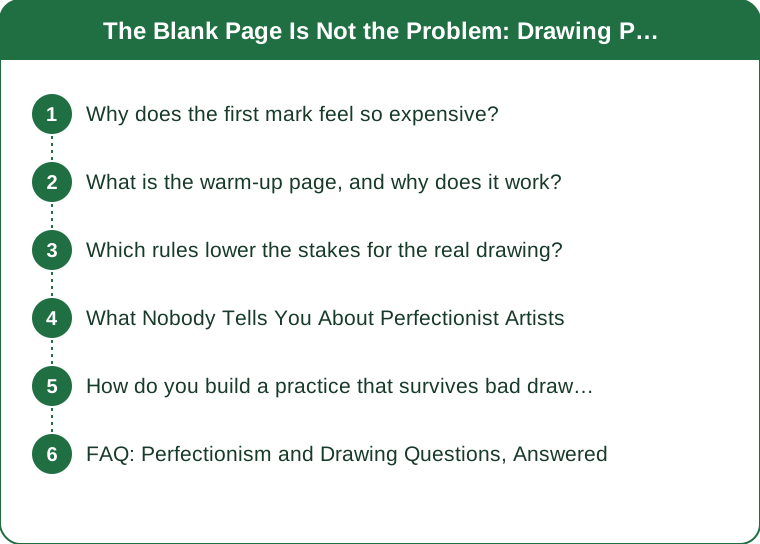
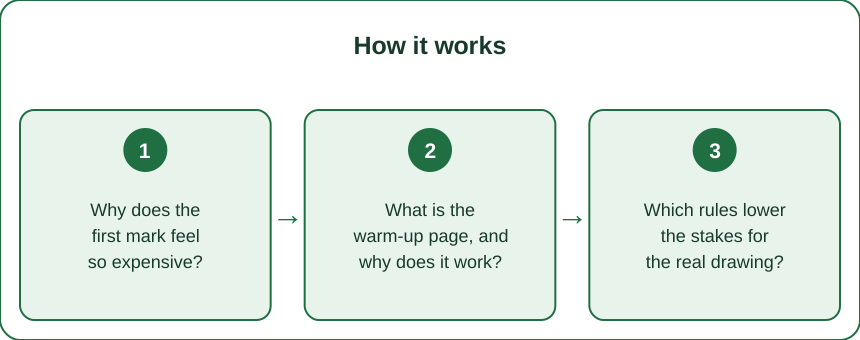
Why does the first mark feel so expensive?
Because for a perfectionist, the blank page is not empty - it is full of a potential verdict.
The mechanism runs like this: an untouched page still contains the perfect drawing you can imagine. The first real mark collapses that possibility into whatever your hands actually produce today - and if your sense of being creative is riding on the outcome, that collapse feels genuinely risky. So the brain does what brains do with risk: it avoids. Not dramatically - just a small preference for tidying, scrolling, sharpening pencils, researching one more tutorial. Procrastination here is not laziness; it is self-protection with excellent camouflage.
The tell-tale signatures that this - not time, not talent - is your actual blocker:
- You prepare far more than you produce: supplies, references, courses, the perfect sketchbook waiting for worthy content
- You abandon drawings at the first wrong line rather than continuing past it
- You draw less the more you care - doodles in meeting margins flow freely, the real sketchbook stays pristine
- Finished-looking work by others makes you want to start less, not more
That last one matters: you are comparing your process to everyone else’s highlights, a fight nobody wins.
The good news is structural: since the block is caused by stakes, it is dismantled by lowering stakes - which is a design problem, not a character overhaul. Every fix in this article is a different way of making a bad drawing cost nothing.
What is the warm-up page, and why does it work?
The single highest-value ritual for a blocked perfectionist: every session begins with one page you are required to ruin.
The rules are strict in the direction of looseness:
- Page one of every session is the sacrifice page. Scribbles, overlapping circles, ten terrible versions of the same eye, your pen scrawled without looking. It does not count, cannot count, and exists to be bad.
- Timed, not judged: two to five minutes. A kitchen timer makes it a procedure instead of a performance.
- It never gets torn out. Removal implies shame; staying implies the book is a workspace, not a gallery.
Why something so silly works on something so stubborn:
It breaks the seal. The expensive mark - the first one - gets spent on a page with no stakes, so by the time you reach the real page, you are already someone who is drawing today. Momentum transfers; dread does not.
It physically warms up the hand. Loose shoulder-driven scribbling genuinely improves the line quality of everything after - athletes would call this obvious.
It rehearses surviving badness. Every session opens with proof that an ugly page changes nothing about your day. Repeated a few dozen times, that evidence starts outweighing the fear - which is exposure therapy wearing an art smock.
Musicians run scales without shame. The warm-up page is scales - and the day it stops feeling like a waste of paper is the day the block has started losing.
Which rules lower the stakes for the real drawing?
Five structural rules, each removing a place perfectionism hides:
1. Draw in pen. Pencil-plus-eraser invites correcting each line toward perfect before moving on - a doom loop that produces one overworked corner and an abandoned page. Pen makes errors permanent, and permanent errors teach the actual skill: continuing anyway. Wrong lines get redrawn beside, not erased - which is also, not coincidentally, how drawing improves fastest.
2. Use cheap paper for daily work. The beautiful sketchbook whispers be worthy of me. A pad of printer paper or a dollar-store notebook whispers nothing. Precious materials are stakes in physical form; save them for occasions, not practice.
3. Set quantity quotas, never quality goals. Ten gesture drawings, three bad chairs, one page of hands - countable, finishable, judgment-free. Quantity quotas convert sessions from did I do well (unanswerable, corrosive) to did I do it (yes). The volume itself quietly delivers the improvement the quality goal was failing to.
4. Timebox small. Fifteen minutes with a hard stop beats an open evening. Short sessions cannot carry masterpiece expectations - there is visibly no room for one - and stopping while it is still easy is what makes tomorrow’s start cheap.
5. Copy freely and say so. Perfectionists gatekeep themselves with originality standards professionals do not hold. Master copies, tutorial follows, and drawing from photos are how every artist you admire trained. Imagination work arrives on top of borrowed structure, not instead of it.
Run all five together and notice what they share: none requires feeling confident. They are scaffolding that works while the feelings catch up.

What Nobody Tells You About Perfectionist Artists
The block targets what you care about most. People blocked at drawing often cook, garden, or write emails with cheerful sloppiness. The stall is not a general character flaw - it is a spotlight showing you exactly where your identity feels exposed. Backwards compliment, but a compliment.
Skill does not cure it - it relocates. Blocked beginners assume confidence arrives at competence. Ask any professional: the bar rises with the ability, and the artists who produce are the ones who built starting rituals, not the ones who stopped feeling the fear. Learning the scaffolding now is not remedial; it is the actual curriculum.
Your taste outrunning your skill is the engine, not the enemy. The gap that makes your drawings disappoint you is the same faculty that will make them good - you can see better than you can execute, which is precisely how execution knows where to grow. The artists in trouble are the ones who cannot see the gap.
Abandoned-at-line-ten drawings teach almost nothing. The learning in any drawing is concentrated in its second half - pushing through the ugly middle stage, solving the problems you created. A finished mediocre drawing outteaches five promising abandonments. Ugly-finished beats pretty-quit, every time.
Nobody is looking. The imagined audience grading your sketchbook does not exist; the humans who do glance at it will say oh nice and think about their lunch. The privacy you already have is a superpower - perfectionism only operates on an audience, and yours is imaginary.
The pristine sketchbook is not potential - it is the block, bound and shelved. A filled book of uneven pages is what an artist’s shelf looks like.
How do you build a practice that survives bad drawings?
The goal shifts from drawing well to being someone who draws - identity built on frequency, not quality. The architecture:
Track streaks, not standards. A calendar chain of days-drawn - even five-minute days - is the only metric. Chains reward showing up, which is the one variable fully in your control, and the visible chain recruits your completionist streak onto your side for once.
End sessions mid-drawing, on purpose. Stop with the second shoe undrawn. Tomorrow’s session then opens with a known, concrete task instead of a blank-page decision - the same trick novelists use ending chapters mid-scene. Re-entry cost is where practices die; this drops it to near zero.
Keep a private book and mean it. One sketchbook that is constitutionally never shown - not to partners, not to the internet. The work made for zero audience is where risk-taking lives, and risk-taking is where improvement lives. Share selected pieces later if you like; protect the sandbox absolutely.
Review monthly, backwards only. Once a month, compare this week’s pages to the oldest pages in the book - never to other artists, never to imagined standards. Backwards comparison is the only one that tells the truth about progress, and it is reliably kinder than you expect.
When a drawing goes wrong, finish it wrong. House rule: every started drawing reaches some end, however rough. This single rule, kept for a month, rewires the abandon reflex - and produces the strange discovery every artist eventually reports: several of the wrong ones, finished, turn out to be the interesting ones.
Perfectionism is a stakes problem. Keep the stakes on the floor long enough, and one ordinary Tuesday you will notice you have been drawing for twenty minutes without once checking whether it was good.
FAQ: Perfectionism and Drawing Questions, Answered
How long until starting stops feeling hard?
With the warm-up page and small timeboxes, most people feel the dread drop within two to three weeks of near-daily practice - not gone, but shrunk from a wall to a speed bump. The start ritual keeps working after that; professionals still use theirs decades in.
Should I take a class, or will being watched make it worse?
A good beginner class helps precisely because everyone visibly struggles - it dismantles the private belief that difficulty is unique to you. Choose process-focused classes (gesture, sketching habits) over polished-outcome ones for now, and keep the private sketchbook running alongside.
Is digital drawing better or worse for perfectionism?
Undo buttons and infinite layers are pencil-and-eraser perfectionism with power tools - endless correcting, nothing finished. If you draw digitally, impose the pen rules artificially: no undo for warm-ups, time limits, flatten early. Many blocked digital artists unstick fastest on paper, where the medium enforces commitment.
What if I genuinely have no time to practice daily?
Then the practice is three five-minute sessions a week, protected like appointments - streak rules apply at any frequency. A tiny consistent practice beats a big aspirational one that never survives contact with your calendar, and five real minutes regularly is more than most pristine-sketchbook owners have drawn this year.
TL;DR:
- The blank-page stall is self-protection: a bad drawing feels like a verdict, so the brain prevents the attempt
- Open every session with a mandatory ruined warm-up page - two minutes, never torn out
- Lower stakes structurally: pen not pencil, cheap paper, quantity quotas, fifteen-minute timeboxes, guilt-free copying
- Finish wrong drawings wrong - the learning lives in the second half you keep abandoning
- Build identity on streaks and end sessions mid-drawing so tomorrow starts itself; review progress backwards only
You were never short on discipline - you were carrying stakes no hobby can bear. Put a sacrifice page at the front, the beautiful sketchbook back on the shelf, and let a hundred cheap, unwatched, half-ugly pages do what waiting for readiness never could.
Keep Reading
This article is for general informational and styling purposes only. Fit, sizing, and product availability may vary.