Why 15 Minutes of Drawing Calms You More Than an Hour Does
Quick Answer: Short art sessions work better for stress relief because the calming effect comes from absorbed attention, not from finished work - and absorption arrives within a few minutes while self-criticism arrives later. Fifteen to twenty minutes captures the benefit before the internal critic gets involved. Long sessions frequently end with evaluation, comparison, and frustration, which undoes the thing you came for.
If you have ever finished a two-hour drawing session feeling worse than when you started, this is why.

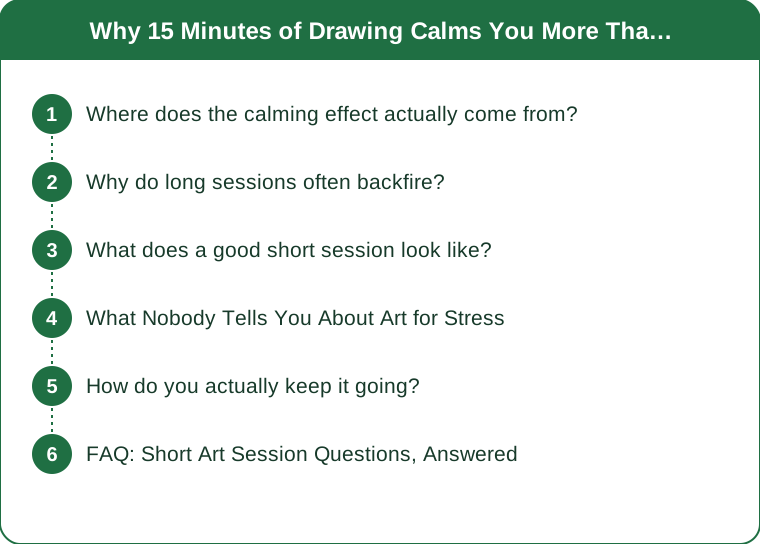
Where does the calming effect actually come from?
From the attentional state, not the output.
When you draw, paint, or colour, your attention narrows onto a repetitive, moderately demanding task with immediate sensory feedback. That state - absorbed, present, not evaluating - is where the settling happens. Research on brief art-making sessions has found reductions in self-reported stress and changes in stress-related markers after sessions as short as 20-45 minutes, regardless of prior artistic experience.
That last part matters: skill level didn’t determine the benefit. The absorption did.
Absorption typically arrives within about three to five minutes of starting, provided the task is engaging enough to hold attention and not so demanding that it triggers effort and frustration.
Which means the useful portion of a session begins early and is fully available in a short window. You aren’t building toward the benefit over an hour - you reach it in minutes and then either stay in it or drift out of it.
Why do long sessions often backfire?
Because a second process starts partway through, and it works against the first.
The critic arrives with the artefact. In the first fifteen minutes, you’re making marks. By minute forty, you have a thing, and a thing can be judged. Attention shifts from the process to the product, and evaluation replaces absorption.
Fatigue changes the experience. Hand fatigue, eye strain, and attentional depletion all accumulate. A task that was pleasantly absorbing at minute ten becomes effortful at minute seventy, and effort in a leisure activity is where resentment starts.
Investment raises the stakes. Fifteen minutes spent is nothing. Two hours spent creates an expectation of a result worth two hours - and if the result disappoints, the disappointment scales with the investment.
Comparison creeps in. Longer sessions produce more finished-looking work, which is more likely to get compared to other people’s finished work.
None of this is an argument against long sessions when you want to make art. It’s an argument against long sessions when what you actually want is to feel calmer.
What does a good short session look like?
Structure matters more than duration, and four elements make the difference.
A timer, set before you start. Fifteen or twenty minutes. The timer isn’t a limit so much as a permission structure - it tells your brain that this is bounded, which removes the resistance to starting.
A small format. A pocket sketchbook, an index card, a page in a notebook. Small formats finish, which means you rarely end mid-thought, and they don’t invite the level of ambition that produces evaluation.
A repetitive or constrained task. Hatching, patterns, contour drawing, filling a shape, one object drawn slowly. Constraint reduces decision-making, and decision-making is what pulls you out of absorption.
No goal for the outcome. The page can be bad. Deciding this in advance, explicitly, is what stops the critic from arriving on schedule.
A practical starting set: ten minutes of blind contour drawing of an object on your table, or filling a card with repeated patterns, or drawing the same mug five times. All of them are dull to describe and reliably absorbing to do.

What Nobody Tells You About Art for Stress
Daily short sessions beat weekly long ones by a wide margin. Fifteen minutes on five days does more for how you feel across a week than ninety minutes on a Sunday. The benefit isn’t cumulative in the way training is - it’s a state you re-enter, so frequency of entry is what counts.
Colouring books work, and the reason isn’t the colouring. They remove every compositional decision, which means you reach absorption almost immediately and stay there. That’s also their limit - some people find them absorbing and others find them boring precisely because there’s nothing to solve.
Difficulty has a sweet spot. Too easy and your mind wanders back to whatever it was chewing on. Too hard and you get frustrated. The right task is one that requires just enough attention to occupy you and not enough to strain.
Digital tools work but carry a cost. A tablet is fine as a medium, and it’s also a device with notifications, an undo button that encourages perfectionism, and an infinite canvas. Paper has constraints that happen to be useful here.
The mess of setup is the real barrier. Anything requiring water, palettes, and cleanup has a fifteen-minute overhead attached to a fifteen-minute session. A pencil and a notebook left visible on a table has none, which is why it gets used.
And a clear boundary: this is a wellbeing practice, not a treatment. Art therapy delivered by a trained therapist is a distinct clinical discipline and is not the same thing as drawing at your kitchen table. If anxiety is significantly affecting your daily life, that’s worth talking to a professional about. This is general information, not medical advice.
How do you actually keep it going?
The failure mode isn’t disliking it - it’s forgetting, and then feeling too far behind to restart.
Attach it to something that already happens. After the kettle boils, after you close the laptop, after dinner is cleared. An anchor event is far more reliable than a time of day.
Leave the materials out. A notebook and one pencil, visible, on the surface where you’ll be. Materials in a drawer effectively don’t exist, and the ten seconds of retrieval is enough friction to end a habit.
Keep one tool, not a collection. Buying supplies is a common substitute for making things, and a large collection creates a decision before every session. One pencil or one pen removes it.
Let the streak break without ceremony. Missing four days means the next session is the next session, not a restart. The habits that survive are the ones with no penalty attached to gaps.
And keep the finished pages. Not to review critically - to notice, six months later, that you did this a hundred times. That’s the only kind of progress worth tracking here.
FAQ: Short Art Session Questions, Answered
Is 15 minutes really enough?
For the calming effect, yes - studies of brief art-making have found measurable changes after single short sessions. If you want to develop skill, that’s a different goal with a different time requirement.
Does it matter what I draw?
Less than you’d think. Repetitive or constrained tasks reach absorption fastest. Subject matter matters mainly in whether it holds your attention.
What if I’m genuinely bad at drawing?
Research on brief art-making has repeatedly found benefits independent of prior experience. The absorption doesn’t require skill, and skill is not the point of this particular practice.
Can I do this on a phone or tablet?
Yes, though the notifications and the undo button work against you. If you use a tablet, turn on do-not-disturb first.
TL;DR:
- The calm comes from absorbed attention, which arrives in minutes and doesn’t need skill
- Long sessions invite evaluation, fatigue, and comparison - all of which undo the benefit
- Structure a short session: timer, small format, constrained task, no outcome goal
- Daily fifteen minutes beats a weekly ninety by a wide margin
- Leave one pencil and one notebook visible; setup friction is what ends the habit
You aren’t making art to have made art. Fifteen minutes gets you the whole thing the hour was supposed to deliver.
Keep Reading
This article is for general informational and styling purposes only. Fit, sizing, and product availability may vary.